
The Trials of Mary Dyer (1659 & 1660)
The Trials of Mary Dyer (1659 and 1660)
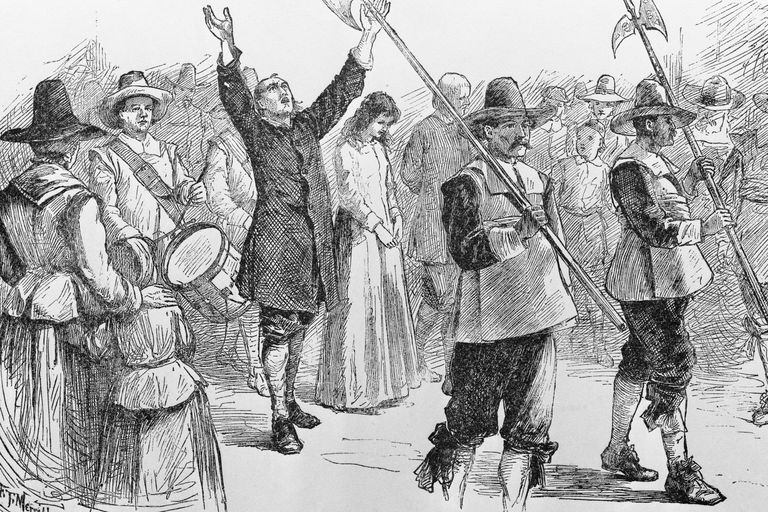
Mary Dyer being led to her execution site in Boston
Mary Dyer was on a spiritual quest. Her quest led her to Boston, to Portsmouth, to Newport, and to the northwest coast of England, where she became an ardent member of a new religion—a Quaker, or a member of the Society of Friends as they were more formally known. Determined to spread the good news, Mary returned to America as a Quaker missionary. But quests do not always end well. Mary’s missionary zeal would ultimately take her to the gallows in Puritan Boston and make her the first and only woman to be executed in America because of her religious beliefs: Mary Dyer, “the Quaker Martyr.”
Dyer’s story reveals much about the intolerance of colonial America in the mid-1600s. But Mary’s martyrdom also contributed to the birth of religious freedom in America. Her story is one of the most compelling stories of the seventeenth century, a time when America was defining itself and much was up for grabs.
Background
In 1610 or 1611, near London in St. Martins-in-the-Field, the woman who would become known as Mary Dyer was born Marie Barrett Almost nothing is known of her parents, who seem to have died when Mary (as we will call he) was young. She had a brother. She was well-educated.
In 1633, Mary married Guillaume (William) Dyer in St. Martin-in-the-Field church. William had been an apprentice for nine years to an importer of fineries from Milan and had established his own business selling small wares. The economy in England was poor at the time and the Dyers explored their options. In 1635, with Mary pregnant, the Dyers paid fifty pounds for passage and set sail for New England. Ten weeks later, they arrived in Boston.
They built a house on Summer Street. The couple slept on the main floor near the fireplace; their indentured servants in a loft above. They settled into Puritan life—a life of Bible reading, Church attending, farming (they shared 240 acres of farmland with ten other families), and daily chores.
The Puritans were all about conformity and community. But the Dyers arrived in Boston just a schisms were developing. Salem . . . Continued